
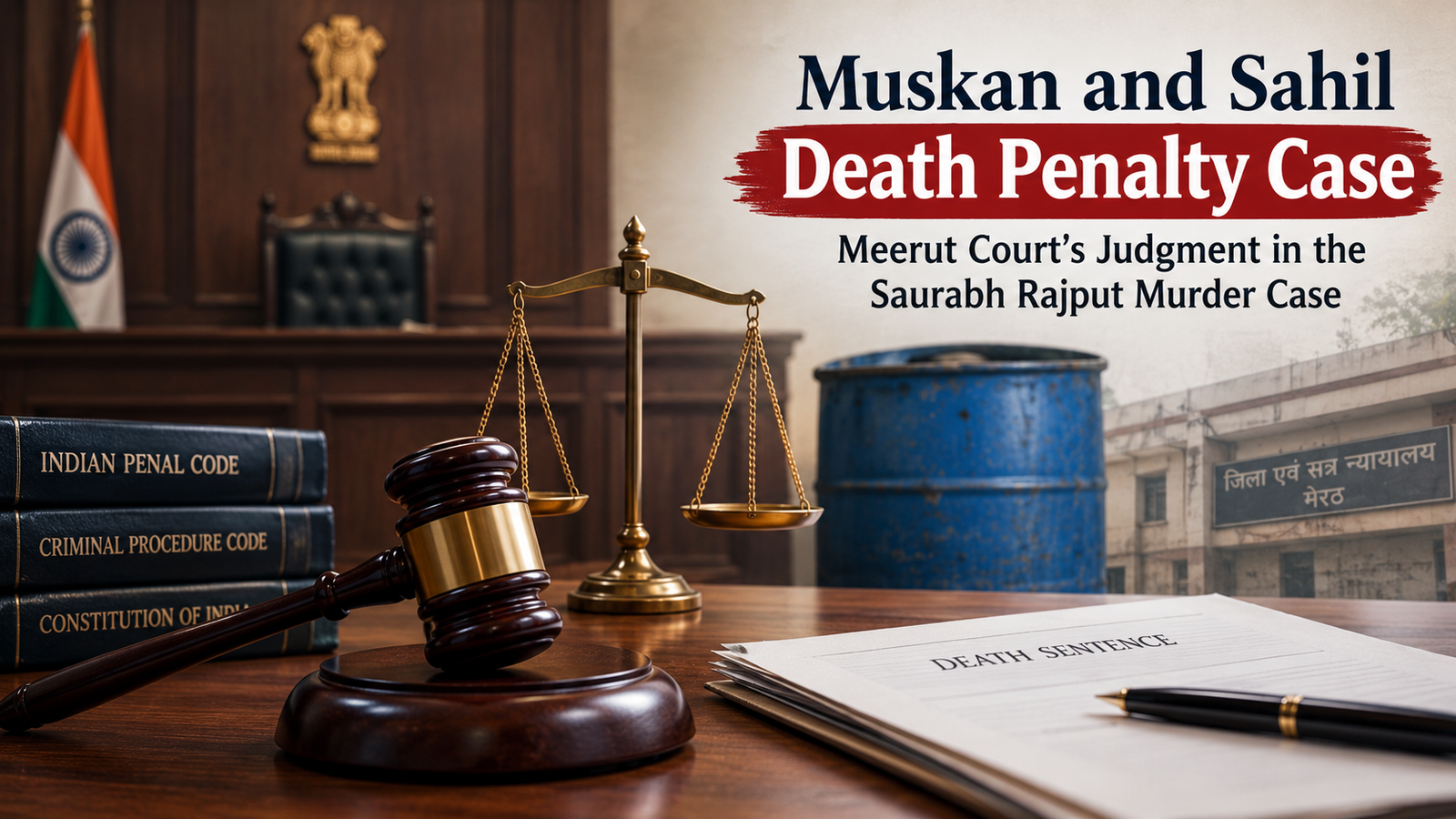
Muskan Sahil Death Penalty Case: Meerut Court Awards Death Sentence in Saurabh Rajput Murder Case
An Overview of the Case
The Meerut blue drum murder case has attracted nationwide attention following the decision of a court in Meerut, Uttar Pradesh, to award the death penalty to Muskan Rastogi and Sahil Shukla for the murder of Saurabh Rajput, Muskan’s husband. The case has raised important questions about criminal responsibility, forensic evidence, the judicial assessment of circumstantial evidence and the legal standards governing capital punishment in India.
On 14 October 2026, the Meerut court sentenced both convicts to death after convicting them of murder and offences relating to the disappearance of evidence. The case had already received considerable public attention because of the circumstances in which the victim’s remains were allegedly concealed.
However, from a legal perspective, the importance of this case extends beyond the nature of the crime. It also highlights the distinction between a trial court’s sentencing decision and the subsequent judicial process required before a death sentence can be executed.
This article examines the reported facts, the legal issues involved, the role of forensic evidence and the applicable principles of Indian criminal law.
What Is the Muskan and Sahil Blue Drum Murder Case?

The case concerns the murder of Saurabh Rajput, a former Merchant Navy officer, in Meerut in March 2025. Muskan Rastogi, his wife, and Sahil Shukla were subsequently investigated in connection with the crime.
According to media reports concerning the prosecution’s case, Saurabh was allegedly killed by the two accused, after which his body was dismembered and concealed in a blue plastic drum containing cement. The crime came to light after people involved in moving the drum became suspicious and alerted the authorities.
The investigation reportedly involved the recovery of physical evidence, medical and forensic material, digital records and witness testimony. The prosecution relied substantially on circumstantial and scientific evidence rather than an eyewitness account of the actual killing.
Muskan and Sahil were convicted by a Meerut court on 30 September 2026. Following the sentencing proceedings, the court awarded them the death penalty on 14 October 2026.
The reported trial involved approximately 126 hearings and the examination of 22 prosecution witnesses.
These facts are based on published reporting. The complete sentencing judgment is necessary for a definitive assessment of the court’s findings, its reasoning and the evidence accepted for each charge.
Why Did the Court Award the Death Penalty?
The death penalty is the most severe punishment available under Indian criminal law. It cannot lawfully be imposed merely because a crime has attracted widespread public outrage or has been described as exceptionally brutal.
Indian courts must apply established legal principles while deciding whether a convicted person should receive capital punishment instead of life imprisonment.
In this case, the prosecution reportedly sought the death penalty, relying on the nature and circumstances of the crime. Media reports also state that the trial judge referred to the Mahabharata while explaining the moral responsibility of the court to punish wrongdoing.
Nevertheless, the precise legal reasoning behind the sentence must be assessed from the written judgment. It would be premature to attribute particular findings or conclusions to the court without examining that document.
The central legal question is whether the circumstances satisfy the stringent requirements established by the Supreme Court for imposing capital punishment.
Understanding the Rarest of Rare Doctrine
The leading authority on the constitutional validity and application of the death penalty is Bachan Singh v. State of Punjab (1980).
In this landmark decision, the Supreme Court upheld the constitutional validity of capital punishment while establishing that the death penalty should be imposed only in the “rarest of rare” cases, when the alternative option of life imprisonment is unquestionably foreclosed.
This principle places strict limits on the sentencing discretion of criminal courts.
What does the doctrine mean?
The doctrine requires courts to undertake a careful and individualised assessment of the offence and the offender. The seriousness of the crime is important, but it is not the only consideration.
Courts must examine the relevant aggravating and mitigating circumstances, including:
The nature and manner of the offence.
The motive and circumstances surrounding the crime.
The degree of participation and responsibility of the individual offender.
The possibility of rehabilitation and reformation.
The availability and adequacy of life imprisonment as an alternative punishment.
The prosecution must establish why the case falls within the exceptional category warranting capital punishment. The court must also consider whether the alternative of life imprisonment is genuinely inadequate.
Consequently, a brutal murder does not automatically result in a legally justified death sentence. The decision must be supported by a reasoned application of the governing principles.
What Is the Legal Significance of the Bachan Singh Judgment?
On 14 October 2026, a Meerut district court sentenced Muskan Rastogi and Sahil Shukla to death for the murder of Saurabh Rajput. Media reports also stated that the court imposed fines in connection with the murder and the offence relating to the disappearance of evidence.
According to reports quoting the prosecution, the judge referred to the Mahabharata while explaining the principle that punishing wrongdoing in accordance with the gravity of the offence is part of the duty of justice.
The prosecution had sought the maximum punishment, referring to the circumstances of the crime and the evidence presented during the trial.
However, the precise legal reasoning behind the sentencing decision must be assessed from the complete written judgment. The final determination of whether capital punishment is justified also remains subject to the applicable legal safeguards.
What Is the Legal Meaning of the Death Penalty in India?
The death penalty, also known as capital punishment, is the most severe criminal punishment available under Indian law for certain offences.
However, Indian courts cannot impose it automatically merely because an offence is particularly brutal or has attracted widespread public attention.
In Bachan Singh v. State of Punjab (1980), the Supreme Court established the “rarest of rare” doctrine. Under this principle, capital punishment should be imposed only in exceptional cases where the alternative option of life imprisonment is unquestionably foreclosed.
Courts must consider the circumstances of the offence, the individual offender’s role, aggravating and mitigating factors, and the possibility of reformation.
The application of this doctrine is central to understanding any death penalty judgment in India, including the Muskan and Sahil case.
Is the Death Sentence Final?
An important legal distinction must be understood: a death sentence awarded by a trial court is not automatically final or immediately executable.
Under Section 407 of the Bharatiya Nagarik Suraksha Sanhita, 2023, a death sentence passed by a Court of Session must be submitted to the High Court for confirmation. It cannot be executed unless the High Court confirms it.
The High Court examines the case under the applicable legal procedure and may confirm the sentence or pass another order permitted by law.
The convicts may also pursue available appellate remedies. Further proceedings before the Supreme Court and other legally available remedies may follow, depending on the circumstances.
Therefore, although the Meerut court has awarded the death penalty to Muskan and Sahil, the sentence remains subject to the mandatory High Court confirmation process.
What Does This Case Mean for Criminal Justice in India?
The Muskan and Sahil case highlights the seriousness with which criminal courts examine grave offences and determine appropriate punishment.
It also demonstrates why the legal process does not end with the announcement of a sentence. The conviction, the evidence supporting it and the proportionality of the punishment must remain subject to judicial scrutiny in accordance with the law.
The case has prompted public discussion about punishment, accountability and justice for victims. Nevertheless, the legal assessment of a death sentence must be based on the judicial record, statutory provisions and binding Supreme Court precedents rather than public opinion alone.https://legalbasta.com/criminal-lawyer-in-delhi/
Conclusion
The death sentence awarded to Muskan Rastogi and Sahil Shukla on 14 October 2026 is a major development in the Saurabh Rajput murder case, widely known as the Blue Drum Murder Case.
The case brings into focus the seriousness of criminal offences, the role of judicial sentencing and the exceptional legal standards applicable to capital punishment in India.
The next significant stage is the judicial confirmation process before the High Court. Until the required legal procedures are completed, the trial court’s death sentence should not be described as a final, executable punishment.