
Introduction
Protest stands as one of the most vital expressions of a functioning democracy, embodying the collective voice of citizens who seek to be heard, acknowledged, and respected. It is through protest that individuals and communities bring attention to social, political, and economic injustices, often catalyzing meaningful change. Rooted in the fundamental freedoms of speech, assembly, and association, the right to protest is not merely a privilege but a cornerstone of democratic societies.
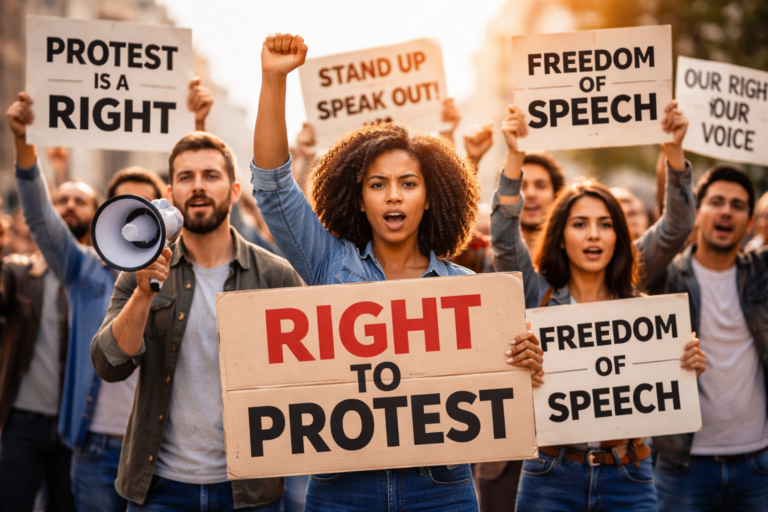
Right to Protest in India – The Fundamental Right
The right to protest, which enables citizens to publicly question, challenge, and seek accountability from the government, is a fundamental political right inherent in a democratic system. It reflects the active participation of the people in governance and underscores the principle that authority ultimately rests with the citizens.
While the right to protest is not explicitly enumerated as a separate Fundamental Right, it is intrinsically derived from the broader framework of Article 19 of the Constitution. In particular, it finds its foundation in the Right to Freedom of Speech and Expression, as well as the freedoms of peaceful assembly and association. These interconnected liberties collectively empower individuals to express dissent, advocate for change, and influence public policy in a lawful and constructive manner.
Thus, the right to protest is not merely an implied freedom but a vital extension of constitutional guarantees, reinforcing democratic values and ensuring that the voices of the people remain central to the functioning of the state.
Right to Freedom of Speech – Article 19(1)(a):
The right to free speech and expression is translated into the freedom to publicly express one’s opinion on the activities of the government.
Right to Freedom of Association- Article 19(1)(b):
It is vital to have the right to form political organizations. These can be organized in order to challenge government activities collectively.
Right to Freedom of Assembly – Article 19(1)(c):
Individuals have the freedom to peacefully congregate in order to question and object to government actions through demonstrations, agitations, and public assemblies, as well as to form long-term protest movements.
When these rights are combined, they allow anybody to peacefully gather and demonstrate against the State’s action or inaction. The protests are for democracy, and the objective of the protest is to protect the integrity of flaws in the country.
Reasonable Restrictions on Right to Protest
The right to protest, like other Fundamental Rights, is not absolute and is subject to reasonable restrictions under Articles 19(2) and 19(3) of the Constitution. These restrictions aim to balance individual freedoms with the larger interests of society and the State. They may be imposed on the following grounds:
The security of the State
The sovereignty and integrity of India
Maintenance of public order
Decency or morality
Contempt of court, defamation, or incitement to an offence
Friendly relations with foreign States
However, restrictions based on public order must meet a strict standard of justification. They are valid only when there is credible evidence that a protest is likely to incite unlawful or disorderly conduct, and that such outcomes are reasonably foreseeable.
This position aligns with international human rights standards. As noted by the United Nations Special Rapporteur on the right to freedom of peaceful assembly, any restriction must be lawful, necessary, and proportionate to the objective it seeks to achieve. Importantly, such limitations should remain exceptional and must not undermine the very essence of the right to peaceful assembly.
Importance of Right to Protest for Democracy
The active exercise of the right to protest empowers citizens to act as vigilant watchdogs, continuously monitoring government actions and ensuring accountability, transparency, and justice in a democratic society.
Protests play a vital role in shaping societies and strengthening democratic values in the following ways:
- Drives Positive Social Change
Protests have historically been catalysts for meaningful social transformation, promoting equality, justice, and the advancement of human rights across the world. - Advances Human Rights Awareness
They encourage the development of an informed, aware, and engaged public that actively participates in civic matters. - Impacts All Aspects of Society
Protests influence civic, political, economic, social, and cultural spheres, making them an essential component of a dynamic and evolving society. - Empowers Marginalized Communities
They provide a platform for underrepresented and marginalized groups to voice their concerns and advocate for their rights. - Strengthens Democratic Values
Protests enhance participatory democracy by enabling citizens to directly engage with public issues and decision-making processes. - Promotes Accountability
They allow individuals and organizations to express dissent, highlight governance shortcomings, and demand transparency and responsibility from authorities and institutions.
International Law on Right to Protest
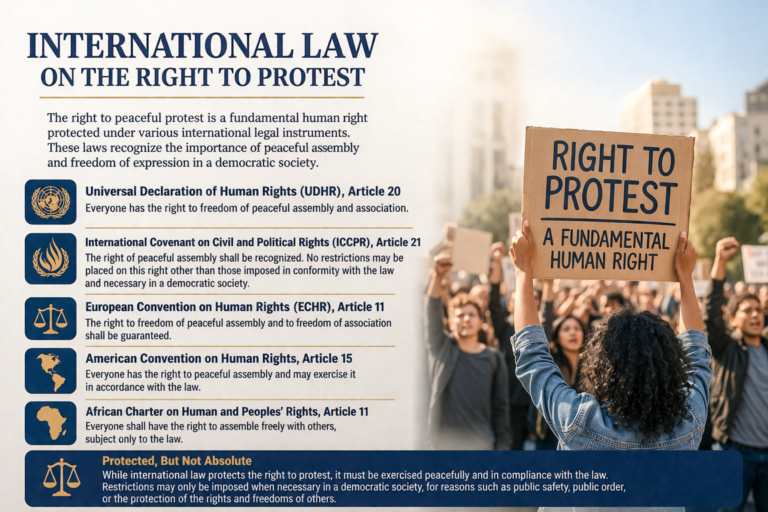
The right to peaceful protest is included in the Universal Declaration of Human Rights of the United Nations, which was ratified in December 1948.
In international law, many treaties, particularly the International Covenant on Civil and Political Rights, recognise the rights to freedom of association, peaceful assembly, and speech.
These rights create the right to protest when they are combined.
Supreme Court’s Judgements on Right to Protest
The Supreme Court has affirmed the right to peaceful protest, observing that democracy and dissent are intrinsically linked. However, it has clarified that demonstrations expressing disagreement should be conducted only in designated public spaces. While the Constitution guarantees the freedom to assemble and express dissent, it is coupled with Fundamental Duties under Article 51A, which require every citizen to safeguard public property and renounce all forms of violence.
Shaheen Bagh Judgement, 2019: The court affirmed the right to peaceful protest against legislation, but cleared that public streets and public areas cannot be occupied forever. Fundamental rights do not exist in isolation. The right of the protestor must be weighed against the right of the commuter, and both must coexist in mutual regard.
Mazdoor Kisan Shakti Sangathan (MKSS) vs. Union of India (2018): In this case, the Supreme Court recognised the basic right to assembly and peaceful protest, but directed that it be controlled so that it does not cause discomfort to residents of Jantar Mantar Road or the offices located there.
Ramlila Maidan Incident vs. Home Secretary, Union of India (2012): The Supreme Court ruled that citizens have a basic right to assemble and demonstrate peacefully, which cannot be revoked by arbitrary administrative or legislative action.
Conclusion
In a democracy, the rights to free expression and peaceful protest are “treasured” and must be nurtured and safeguarded. The most important argument made by the court specifically is that peaceful protest is a fundamental right of protestors and that peaceful protest should be tolerated. However, the right to protest can be curtailed if it infringes the rights of others, causing severe issues for the common public such as the potential of a roadblock, discomfort, or a protest that disrupts everyday life.