
Cyber Harassment in India: Laws, Rights & Legal Remedies
India has emerged as one of the fastest-growing digital ecosystems, with millions of users actively engaging across diverse social media platforms. While these platforms enable communication, creativity, and community-building, they also expose users to the growing threat of cyber harassment. In this evolving digital landscape, individuals may find themselves vulnerable to harmful online behavior that transcends platform boundaries.
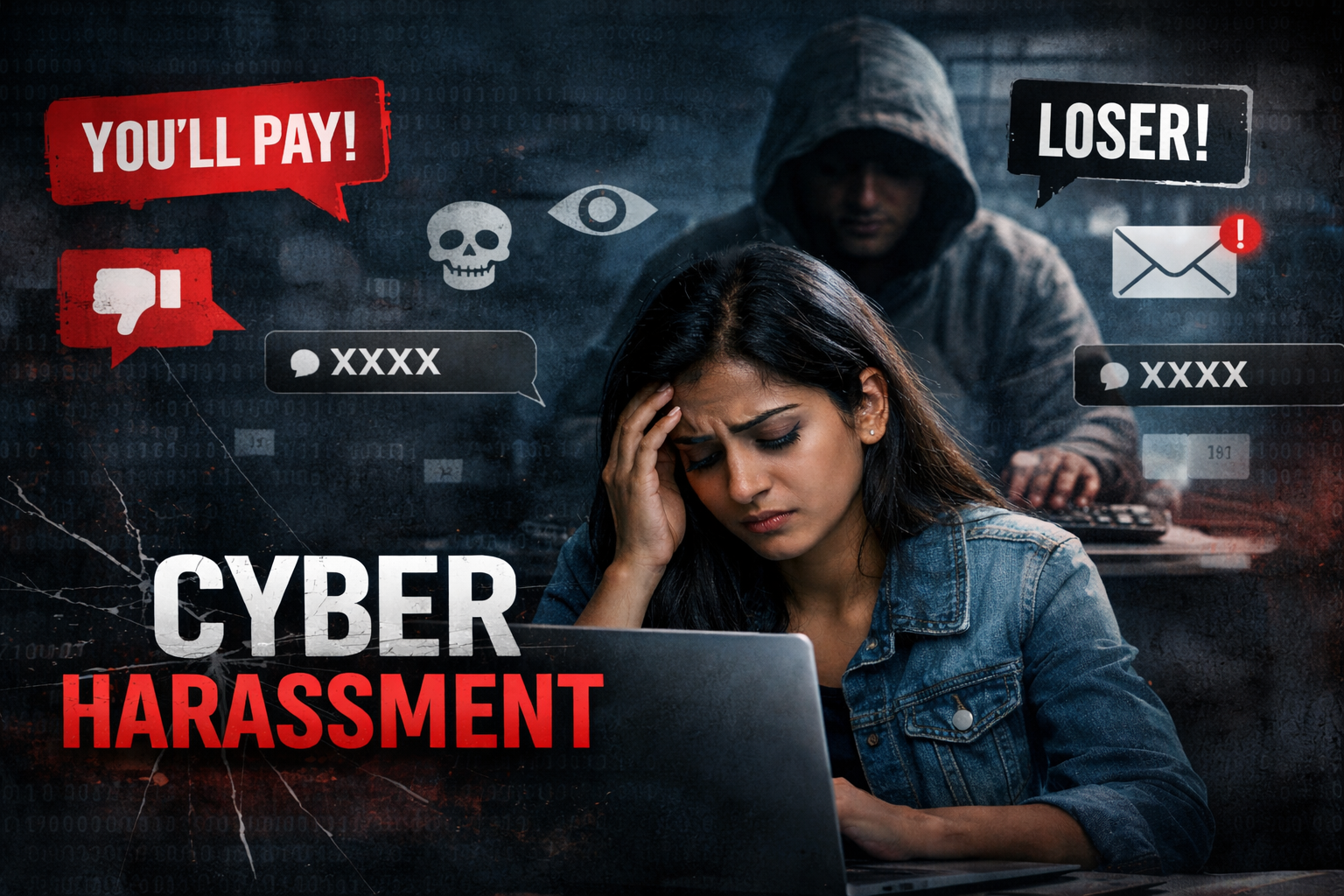
Cyber abuse and cyber harassment—often used interchangeably—refer to the persistent or severe targeting of individuals or groups through damaging, intimidating, or degrading conduct in online spaces. As defined by PEN America, such behavior undermines digital safety and personal dignity, making it a critical issue that demands awareness, accountability, and stronger protective measures in today’s interconnected world.
Types of Cyber Harassment
The act of intentionally provoking conflict or hostility in online communities by posting offensive, inflammatory, or irrelevant content. Often carried out by individuals or groups known as “trolls” to disrupt discussions and incite reactions.
Includes explicit threats of violence, intimidation, and sexually abusive messages—commonly targeted at women, public figures, and individuals expressing opinions online.
Cyber Stalking
Persistent monitoring, tracking, and harassment of individuals through digital platforms such as social media, emails, and messaging services, affecting privacy and personal safety.
Doxing
The unauthorized collection and public disclosure of sensitive personal information (e.g., addresses, phone numbers, identification details) to intimidate or silence individuals.
A deliberate attempt to harm an individual’s reputation through false allegations, defamatory statements, or unjustified public criticism.
Cyberbullying
A broad form of online harassment where individuals are repeatedly targeted using digital platforms to intimidate, shame, or emotionally harm them.
What Are the Cyber Harassment Laws in India?
Cyber harassment victims can seek redress under a number of legal provisions. There might, however, be a knowledge gap in the populace. It’s possible that they are unaware of their rights.
What rights are available under the social media harassment laws in India? Well, they are nestled under the following Acts:
Indian Penal Code, 1980
The general penal code for India is known as the Indian Penal Code, or IPC. Following the “Nirbhaya” incident, the Act underwent some significant revisions to make it more thorough and comprehensive. The IPC forbids sexual innuendos, stalking, voyeurism, and outraging a woman’s modesty even if law doesn’t address Cyber harassment. It also makes unlawful acts of criminal intimidation and slander.
Section 298 criminalises hate speeches aimed at damaging the religious sentiments of individuals.
Section 354A proscribes the many forms of sexual harassment like forcefully showing pornography, making unwelcome physical contact and sexual advances. Demanding or requesting sexual favours and making sexually coloured remarks are also punishable offences.
Section 354C makes voyeurism a punishable offence. It means the act of watching or capturing the image of a woman engaging in a private act, without her permission or consent. Moreover, it is punishable to disseminate such images without the victim’s permission, even if she consented to be captured.
Section 354D punishes every form of stalking including Cyber stalking. An alleged offender must prove that his act was reasonable, justified, and pursued under law, for preventing or detecting a crime. Thus, stalking will not attract punishment only in such circumstances.
Section 499 criminalises defamation, or the act of tarnishing the reputation of an individual through words, signs, or visible representations.
Section 503, 506, and 507 proscribes criminal intimidation. It includes the threat to cause grievous injury or worse still—death. Incidentally, the threat to property, or reputation is also covered under the aegis of criminal intimidation. Additionally, criminal intimidation can be with regards to the reputation of the deceased also.
Section 509 criminalises insulting the modesty of a woman through any act, gesture, or word, and violating her privacy.
Information Technology Act, 2000
A specialised legislation to deal with electronic communications and technology; the Information Technology Act, 2000 (IT Act) contains various protective measures.
Section 66C makes identity theft using fraudulent or dishonest means a punishable offence.
Section 66E criminalises the intentional capture, publication, or dissemination of the images of the private areas of any person without his/her consent. This section protects victims of all genders.
Section 66F deals with acts of cyber terrorism including DoS attacks, and the hacking of electronic devices.
Section 67 makes publication or transmission of obscene and lascivious material over electronic medium a punishable offence. It includes sharing pornographic clips or images, obscene messages and screening photos and videos of illegal activities over the internet.
Section 67A forbids transmission or publication of sexually explicit act or conduct over electronic media.
Section 67B criminalises the publication or transmission of material depicting children engaging in a sexually explicit act or conduct. Furthermore, this Section proscribes the download and search for such perverted material. Additionally, the Act condemns acts of facilitating Cyber child abuse, recording child sexual abuse, or enticing or inducing children for a sexual relationship.
Indecent Representation of Women (Prohibition) Act, 1986
Section 4 bars the production, distribution or circulation of any material containing indecent representation of women in any form.
The Sexual Harassment of Women at Workplace Act, 2013
The entire Act is aimed at preventing sexual harassment of women. Section 2(n) defines “sexual harassment” but does not specify any medium. Besides, Section 2(o) defines “workplace” to include “a dwelling place or a house” as well.
Remedies
- We have seen so far what protections the Indian laws against Cyber harassment afford us. Understanding the rights is not sufficient, though. Therefore, we must be able to exercise our rights and get access to the various legal remedies for Cyber abuse.
- In India, sufferers can choose from a variety of therapies. Three options are suggested for investigation by the Center for Advanced Research in Digital Forensics and Cyber Security (ARDC). Social media platforms, the National Commission for Women, and cyber cells are among them.
- Social Media Websites – Cyber social media platforms to spread awareness. Send complaints to the various grievance support departments of the relevant social media network about offensive content and perverse behaviour.
National Commission for Women and the Ministry of Women and Child Development
Cyber Cell and F.I.R.
To aid cybercrime victims, the National Cyber Crime Reporting Portal was established. You can contact the proper authority by using their list of Nodal Officers for the cyber cell of each State.
Additionally, you have the option of submitting a First Information Report (F.I.R.) to your neighborhood police department. Problems with jurisdiction shouldn’t arise in this situation. The F.I.R. will therefore serve as evidence of your quick action.
Conclusion
One can only be as cautious as they can be when using social media. As a result, being computer savvy will help to guarantee that your internet presence is well-secured. Here are some hints that will steer you in that direction:
- Maintain the privacy of sensitive information including your birthdate, address, Aadhar number, and financial details.
- Don’t keep private images on any of your technological gadgets that have cloud storage or an internet connection.
- Use caution when sharing information about your whereabouts and while sharing what you share.
- Additionally, refrain from opening any suspicious file attachments or hyperlinks.
- In addition, unless absolutely required, cover the web camera.
- Keep a reliable antivirus program installed at all times, and update your software frequently.
- Above all, be mindful of internet safety recommendations.