
Right to Die and Euthanasia in India: Legal Framework, Cases & Key Insights
The Right to Die and Euthanasia in India has emerged as one of the most significant constitutional and medico-legal issues in modern Indian jurisprudence. It raises a profound constitutional question: Does the Right to Life guaranteed under Article 21 of the Constitution of India also encompass the Right to Die with Dignity?
Advancements in medical science have enabled life to be prolonged through artificial means, often presenting difficult ethical and legal dilemmas when recovery is no longer possible. Families, healthcare professionals, and courts are frequently confronted with decisions involving patients suffering from irreversible illnesses, persistent vegetative states, or terminal medical conditions.
Recognizing these challenges, the Supreme Court of India has gradually developed a legal framework that seeks to balance the sanctity of life with the principles of human dignity, personal autonomy, and compassionate healthcare. Through landmark judgments such as Aruna Ramachandra Shanbaug v. Union of India (2011) and Common Cause v. Union of India (2018), the judiciary legalized passive euthanasia under strict safeguards and recognized Living Wills (Advance Directives) as legally enforceable.
This comprehensive guide by LegalBasta explains the legal meaning of euthanasia, its constitutional basis, landmark judicial decisions, statutory provisions, ethical concerns, and the current legal position in India.
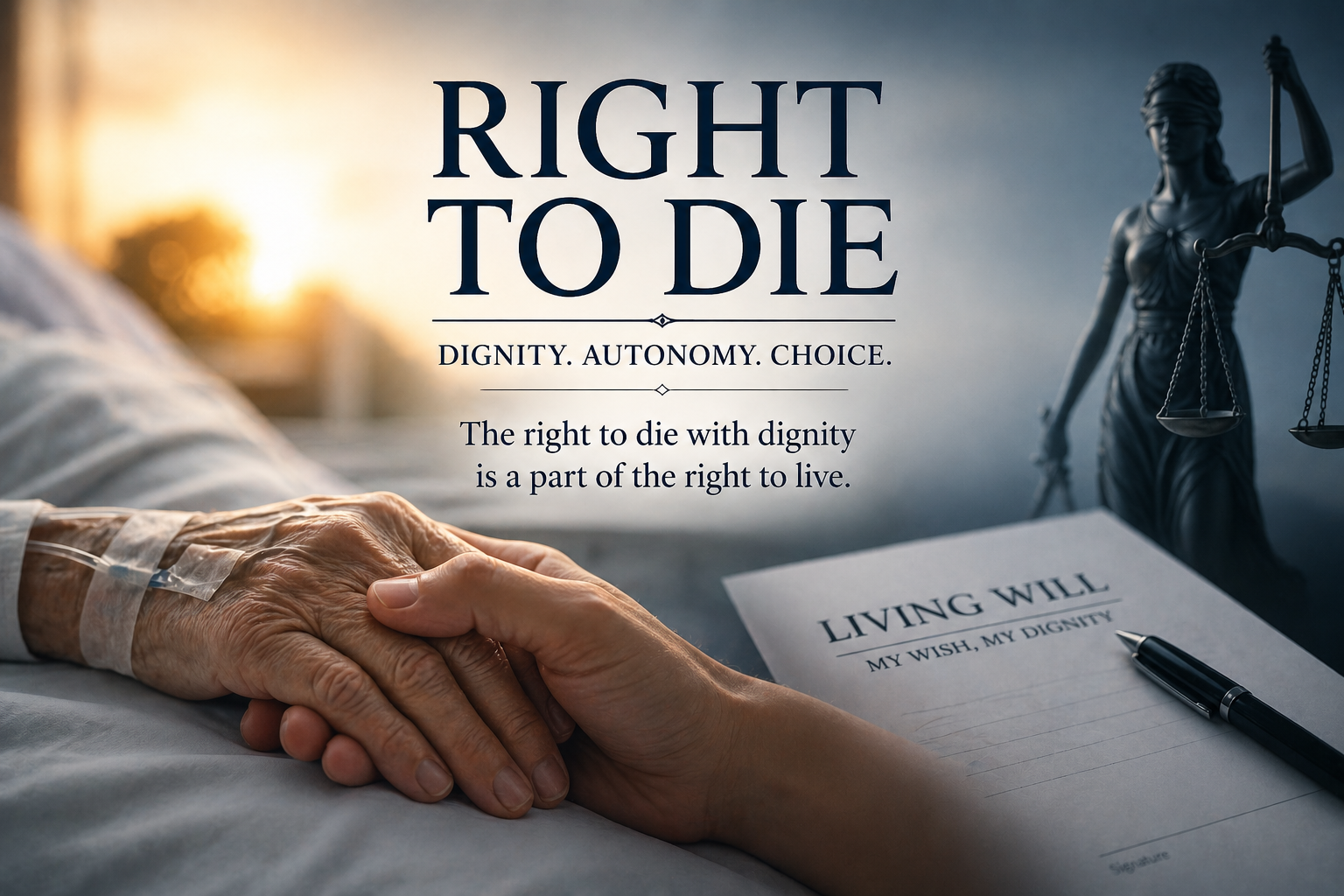
What is the Right to Die?
The Right to Die refers to the claim that an individual should have the legal autonomy to refuse life-prolonging medical treatment or choose a dignified end-of-life process when suffering from an irreversible or terminal medical condition.
In India, the concept is not recognized as an unrestricted fundamental right. Instead, the Supreme Court has clarified that while there is no constitutional right to end one’s life, there exists a limited Right to Die with Dignity, which forms an integral part of Article 21 under specific circumstances.
The emphasis is therefore not on facilitating death but on preserving the dignity of an individual during the final stages of life.
Understanding Euthanasia
Euthanasia is the intentional act of ending or allowing the end of a person’s life to relieve unbearable pain and suffering caused by a terminal or incurable illness.
Indian law classifies euthanasia into two categories.

Active Euthanasia
Active euthanasia involves a deliberate act that directly causes the patient’s death.
Examples include:
Administering a lethal injection
Giving overdose medication intended to cause death
Physician-assisted killing
Legal Status
Active euthanasia remains illegal in India and may attract criminal liability under the Bharatiya Nyaya Sanhita (formerly the Indian Penal Code), depending on the facts of the case.
Passive Euthanasia
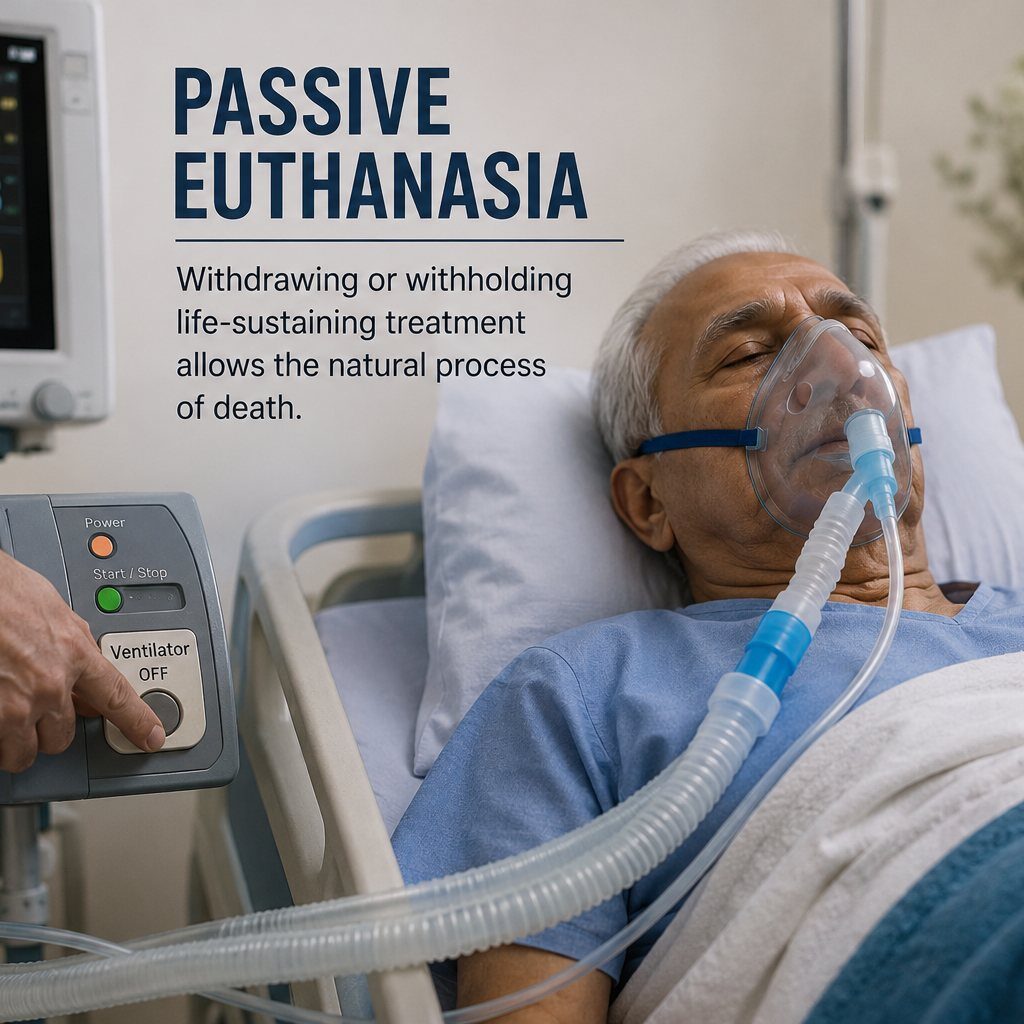
Passive euthanasia involves allowing nature to take its course by withdrawing or withholding extraordinary life-support measures.
Examples include:
Removing ventilator support
Discontinuing artificial nutrition
Stopping life-sustaining medication
Not initiating aggressive life-support procedures
Legal Status
Passive euthanasia is legal in India, subject to strict procedural safeguards prescribed by the Supreme Court.
Constitutional Framework: Article 21
Article 21 of the Constitution states:
“No person shall be deprived of his life or personal liberty except according to procedure established by law.”
Initially, Article 21 was interpreted narrowly.
However, over time, judicial interpretation expanded its scope to include:
Right to live with dignity
Right to privacy
Right to healthcare
Right to personal autonomy
The Supreme Court ultimately held that dignity must extend to the final stages of life, thereby recognizing the Right to Die with Dignity under carefully regulated circumstances.
Landmark Supreme Court Judgments
1. P. Rathinam v. Union of India (1994)
The Supreme Court initially held that the Right to Life included the Right to Die and declared Section 309 IPC unconstitutional.
This interpretation, however, was later overruled.
Significance
First judicial recognition of the debate.
Later declared incorrect by a Constitution Bench.
2. Gian Kaur v. State of Punjab (1996)
This Constitution Bench held that:
Article 21 does not include the Right to Die.
However, the Right to Die with Dignity during the natural process of death forms part of Article 21.
Significance
This judgment became the constitutional foundation for future euthanasia jurisprudence.
3. Aruna Ramachandra Shanbaug Case (2011)
Aruna Shanbaug remained in a persistent vegetative state for over four decades after a brutal assault.
The Supreme Court:
Legalized passive euthanasia.
Allowed withdrawal of life support in exceptional circumstances.
Required approval from the concerned High Court.
Significance
This judgment marked India’s first legal recognition of passive euthanasia.
4. Common Cause v. Union of India (2018)
This Constitution Bench judgment transformed Indian constitutional law.
The Court held:
Right to Die with Dignity is part of Article 21.
Passive euthanasia is constitutionally valid.
Living Wills are legally enforceable.
Patient autonomy deserves constitutional protection.
Significance
It remains the governing law on euthanasia in India.
Living Will (Advance Directive)
A Living Will is a written legal document through which a competent adult expresses future medical treatment preferences if they become incapable of communicating their wishes.
It may include:
Refusal of artificial ventilation
Refusal of CPR
Refusal of prolonged life-support
Appointment of an authorized healthcare representative
The Supreme Court recognized Living Wills to ensure that patients retain autonomy over end-of-life medical decisions while maintaining safeguards against misuse.
Supreme Court Guidelines
To prevent abuse, the Court laid down procedural safeguards, including:
Evaluation by qualified medical experts.
Review by independent medical boards.
Verification of the patient’s medical condition.
Documentation of medical opinions.
Compliance with judicially prescribed procedures.
Respect for valid Advance Directives.
These safeguards aim to protect both patient rights and medical practitioners.
Ethical and Legal Challenges
Despite judicial recognition, euthanasia remains a sensitive issue.
Arguments Supporting Passive Euthanasia
Protects human dignity.
Prevents prolonged suffering.
Respects patient autonomy.
Reduces unnecessary medical intervention.
Recognizes informed consent.
Arguments Against
Risk of coercion or misuse.
Religious and moral objections.
Ethical duties of doctors.
Possibility of incorrect medical prognosis.
Protection of vulnerable patients.
The legal framework seeks to balance these competing concerns through judicial oversight and medical safeguards.
Current Legal Position in India
At present, the legal position is clear:
✅ Passive euthanasia is legal.
✅ Living Wills are legally valid.
✅ Right to Die with Dignity forms part of Article 21.
❌ Active euthanasia remains illegal.
❌ Physician-assisted suicide is not legally recognized.
Why Understanding Euthanasia Laws Matters
Knowledge of euthanasia law is important for:
Patients with terminal illnesses.
Family members making difficult medical decisions.
Hospitals and healthcare institutions.
Doctors and medical practitioners.
Lawyers and legal professionals.
Medical students.
Constitutional law researchers.
Understanding the legal framework ensures that end-of-life decisions are made lawfully, ethically, and compassionately.
Conclusion
The law relating to the Right to Die and Euthanasia in India reflects the Indian judiciary’s effort to harmonize constitutional values with evolving medical realities. While the law continues to protect the sanctity of life, it also acknowledges that dignity, autonomy, and compassion are inseparable components of the Right to Life under Article 21.
The recognition of passive euthanasia and Living Wills marks a significant milestone in India’s constitutional journey, ensuring that individuals facing irreversible medical conditions are not compelled to endure unnecessary suffering through prolonged artificial life support. At the same time, strict judicial and medical safeguards help prevent misuse and protect vulnerable patients.
As healthcare technologies advance and societal perspectives continue to evolve, the legal landscape surrounding euthanasia is likely to develop further. Individuals, families, healthcare providers, and legal professionals should remain informed about these legal principles to ensure that end-of-life decisions are made with compassion, dignity, and full compliance with Indian law.