
Maintenance Law in India: A Critical Analysis of Recent Supreme Court Judgments
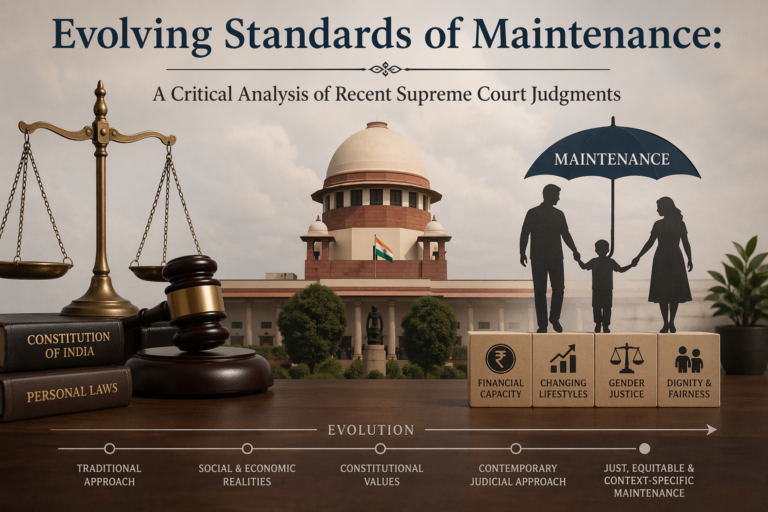
Maintenance law has evolved significantly over time in India, transforming from a basic social protection mechanism into a more structured and equitable system of legal rights. Earlier, the primary objective of maintenance was to prevent individuals, especially dependent spouses, from falling into poverty. However, recent Supreme Court judgments have expanded this perspective, emphasizing fairness, dignity, and a more realistic assessment of financial needs.
In the past, maintenance was largely viewed as a minimal financial support system. Today, courts consider various factors such as the standard of living enjoyed during the marriage, the income and earning capacity of both parties, and their present financial and social circumstances. These evolving interpretations, guided by landmark rulings, reflect a shift towards ensuring a balanced and just outcome rather than mere subsistence.
The legal framework governing maintenance in India remains complex due to the existence of multiple overlapping statutes. Key provisions include Section 125 of the CrPC (now replaced by Section 144 of the BNSS), the Protection of Women from Domestic Violence Act, 2005, the Hindu Marriage Act, 1955, the Hindu Adoptions and Maintenance Act, 1956, and various personal laws. While these laws aim to provide effective remedies, their simultaneous operation often results in procedural delays, inconsistent decisions, and interpretational challenges—issues that have also been addressed in several Supreme Court judgments.
Legal Framework Governing Maintenance
The maintenance law in India is governed by a combination of secular laws and personal laws, creating a comprehensive yet complex legal framework. Over time, Supreme Court judgments have played a crucial role in interpreting these provisions and ensuring uniformity in their application.
1. Section 125 CrPC / Section 144 BNSS
One of the most important provisions under maintenance law in India is Section 125 of the Code of Criminal Procedure (now replaced by Section 144 of the Bharatiya Nagarik Suraksha Sanhita). This provision offers a summary and speedy remedy to wives, children, and parents who are unable to maintain themselves. The primary objective is to prevent destitution and ensure basic financial support, a principle repeatedly reinforced in various Supreme Court judgments.
2. Protection of Women from Domestic Violence Act, 2005
The Protection of Women from Domestic Violence Act, 2005 strengthens the scope of maintenance law in India by allowing women to claim monetary relief in situations involving domestic abuse. Courts, guided by progressive Supreme Court judgments, have interpreted this law broadly to ensure financial security and protection of women’s rights.
3. Hindu Marriage Act, 1955
Under the Hindu Marriage Act, 1955, provisions for interim and permanent alimony are available during matrimonial proceedings. This statute plays a vital role within the broader maintenance law in India, enabling courts to grant financial support based on fairness, lifestyle, and financial capacity—factors emphasized in recent Supreme Court judgments.
4. Hindu Adoptions and Maintenance Act, 1956
The Hindu Adoptions and Maintenance Act, 1956 specifically deals with the maintenance rights of wives, children, and dependents within Hindu law. It provides detailed guidelines on entitlement and obligations, forming a key pillar of the maintenance law in India framework.
5. Personal Laws and Overlapping Remedies
In addition to these statutory provisions, maintenance law in India is also influenced by various personal laws applicable to different religious communities. While multiple remedies are intended to provide broader relief, they often lead to parallel proceedings and conflicting decisions.
Recognizing this issue, recent Supreme Court judgments have taken steps to streamline the process by discouraging multiplicity of proceedings and promoting consistency in maintenance awards.
Key Judicial Developments
Rajnesh v. Neha (2021) 2 SSC 324
Landmark Supreme Court Judgment on Maintenance Law in India
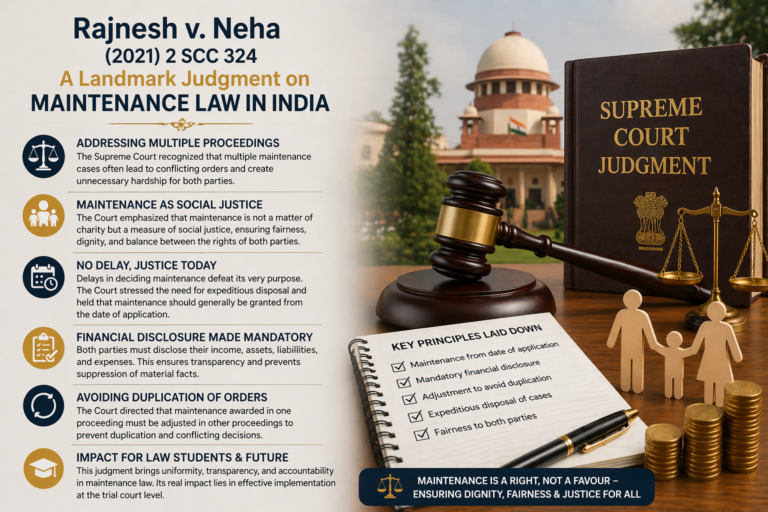
A landmark ruling by the Supreme Court has significantly shaped the maintenance law in India, particularly by addressing the issue of multiple maintenance proceedings leading to conflicting orders. This judgment reinforces the idea that maintenance is not just financial support but a tool of social justice aimed at ensuring fairness and dignity for both parties.
Key Observations by the Court
The Supreme Court made several important observations that have strengthened the framework of maintenance law in India:
- Maintenance is a measure of social justice, not merely a legal obligation.
- Courts must ensure fairness and balance between both parties.
- Delays in deciding maintenance cases defeat the purpose of timely relief.
- There is a strong need for uniform guidelines to maintain consistency across cases.
Important Guidelines Issued
To improve the effectiveness of maintenance law in India, the Court laid down the following key directions:
- Maintenance from Date of Application:
Maintenance should generally be awarded from the date of filing the application to prevent financial hardship. - Mandatory Financial Disclosure:
Both parties must disclose their income, assets, and liabilities to ensure transparency and fair assessment. - Adjustment of Multiple Awards:
Courts must adjust maintenance granted in different proceedings to avoid duplication and conflicting orders. - Focus on Timely Disposal:
Courts should ensure speedy resolution of maintenance cases to uphold justice.
Impact on Maintenance Law in India
This judgment has played a crucial role in bringing transparency, uniformity, and consistency to the maintenance law in India. It helps reduce unnecessary litigation and ensures that maintenance awards are fair and practical.
Law Student’s Perspective
From an academic and practical viewpoint, this landmark decision strengthens the foundation of maintenance law in India by promoting clarity and accountability. However, its real impact depends on effective implementation at the trial court level, where delays and procedural challenges still remain.
Shailja v. Khobbanna (2018) 12 SCC 199: Key Insight into Maintenance Law in India
The Supreme Court judgment in Shailja v. Khobbanna (2018) 12 SCC 199 is a significant ruling that clarified an important aspect of maintenance law in India—whether a wife’s earning capacity alone is sufficient to deny maintenance.
Issue Before the Court
The primary question before the Court was:
Can maintenance be denied solely on the basis that the wife is capable of earning?
Key Observations by the Supreme Court
The Court, through this important ruling, made the following observations:
- Earning Capacity vs Actual Income:
Merely having the ability to earn does not mean that the person is actually earning. - Financial Reality Matters:
Courts must assess the actual income and financial condition, not just theoretical earning potential. - Protection of Dependent Spouses:
The judgment reinforces that maintenance law in India aims to protect economically weaker spouses from financial hardship.
Legal Principle Established
The Supreme Court held that:
Maintenance cannot be denied solely on the ground that the wife is capable of earning.
Instead, courts must consider:
- Whether the spouse is actually earning
- Whether the income is sufficient for sustenance
- The overall financial position of both parties
This principle has strengthened fairness within maintenance law in India.
Impact on Maintenance Law in India
This judgment plays a crucial role in shaping maintenance law in India by ensuring that financial support is not denied on unrealistic assumptions. It promotes a more practical and just approach in maintenance cases.
Critical Analysis
While the decision safeguards the rights of economically weaker spouses, it also raises certain concerns:
- There is a possibility of misuse if earning capacity is intentionally not utilized.
- Courts must carefully balance genuine need vs potential misuse.
- Proper financial assessment becomes essential to avoid unfair outcomes.
Conclusion
The ruling in Shailja v. Khobbanna is a progressive step in strengthening maintenance law in India, as it prioritizes real financial conditions over assumptions. However, its effectiveness depends on careful judicial scrutiny to maintain fairness and prevent misuse.
Recent Judicial Trends in Maintenance Law in India: A Balanced Approach
Maintenance law in India has evolved significantly over the years, reflecting changing social realities and the growing need for fairness in family law disputes. The primary objective of maintenance law is to ensure that individuals who are financially dependent—such as spouses, children, or parents—are not left without support after separation or divorce.
In recent times, courts in India have taken active steps to reform and strengthen maintenance law. These judicial developments aim to make maintenance more realistic, timely, and effective. At the same time, courts are trying to strike a balance between the needs of the claimant and the financial capacity of the respondent.
However, despite these progressive changes, challenges remain in implementation. This article explores recent judicial reinforcements, emerging trends in maintenance jurisprudence, the debate on gender neutrality and misuse, practical challenges, and the future direction of maintenance law in India.
1. Recent Judicial Reinforcements in Maintenance Law
Recent developments in maintenance law in India clearly show that courts are working toward making the system more practical and fair. The judiciary has recognized that delays and unrealistic orders can defeat the very purpose of maintenance.
a. Focus on Timely Grant of Maintenance
One of the most important changes is the emphasis on granting maintenance without unnecessary delay. Courts have increasingly acknowledged that:
- Delayed maintenance defeats justice
- Financial support is often urgently required
- Interim maintenance should be granted quickly
As a result, there is a growing effort to ensure that maintenance applications are decided promptly, providing immediate relief to those in need.
b. Realistic and Practical Maintenance Amounts
Courts are now focusing on fixing maintenance amounts that are realistic and practical. Instead of arbitrary figures, judges consider:
- The standard of living during the marriage
- Income and financial status of both parties
- Cost of living and inflation
- Existing financial responsibilities
This ensures that maintenance orders are fair and sustainable, preventing undue hardship for either party.
c. Balancing the Interests of Both Parties
Modern maintenance law reflects a balanced approach. Courts are trying to:
- Protect the financial dignity of the claimant
- Avoid placing an excessive burden on the respondent
This balanced perspective ensures fairness and promotes trust in the legal system.
d. Making Maintenance Effective in Real-Life Situations
Another significant development is the focus on practical implementation. Courts are increasingly considering real-life factors such as:
- Employment opportunities
- Lifestyle and living conditions
- Financial liabilities
This ensures that maintenance orders are not just theoretical but can actually be enforced effectively.
e. Gap Between Judicial Intent and Ground Reality
Despite these improvements, implementation at the ground level remains inconsistent. Issues such as delays, lack of enforcement, and procedural inefficiencies continue to affect the effectiveness of maintenance law in India.
Overall, recent judicial reinforcements indicate a clear shift toward a more fair, balanced, and practical approach.
2. Emerging Trends in Maintenance Jurisprudence
Maintenance jurisprudence in India is evolving with clear patterns that aim to bring consistency, transparency, and fairness into the system.
a. Move Toward Structured Guidelines
Courts are increasingly adopting structured guidelines to reduce confusion and inconsistencies. This includes:
- Standardizing factors for calculating maintenance
- Creating uniform procedures
- Reducing judicial discretion where possible
Such guidelines help ensure that similar cases are treated in a similar manner.
b. Increased Emphasis on Financial Disclosure
Transparency has become a key element in maintenance law. Courts now require both parties to disclose:
- Income details
- Assets and investments
- Liabilities and expenses
This ensures that maintenance decisions are based on accurate financial information and reduces the chances of manipulation.
c. Protection of Dignity and Standard of Living
Modern maintenance law goes beyond mere survival. Courts emphasize that:
- A person should be able to live with dignity
- Maintenance should reflect a reasonable standard of living
This approach recognizes that financial support is not just about basic needs but also about maintaining social and personal dignity.
d. Balancing Competing Interests
Courts are increasingly focused on balancing the interests of both parties. This means:
- Ensuring adequate support for the claimant
- Preventing excessive financial burden on the respondent
This balanced approach is essential for achieving fairness in maintenance cases.
e. Inconsistent Application of Principles
While these trends are positive, they are not always applied consistently in practice. Variations in judicial interpretation and procedural delays can lead to uneven outcomes.
3. Gender Neutrality and Misuse Debate in Maintenance Law
One of the most debated issues in maintenance law in India today is the question of gender neutrality and misuse.
a. Traditional Approach to Maintenance Law
Historically, maintenance law has been designed to protect women, considering their economic dependence in many situations. This approach aimed to address gender inequality and provide financial security to women after separation or divorce.
b. Changing Social Conditions
With changing social dynamics, there is a growing debate about whether maintenance law should become gender-neutral. Key factors driving this debate include:
- Increased participation of women in the workforce
- Financial independence of spouses
- Changing family structures
These developments challenge traditional assumptions about dependency.
c. Concerns Regarding Misuse
Another important issue is the concern about misuse of maintenance provisions. Some common concerns include:
- Concealment of income or assets
- Filing exaggerated claims
- Prolonging legal proceedings unnecessarily
Such practices can undermine the fairness of the legal system.
d. Judicial Response to Misuse
Courts have attempted to address misuse by:
- Emphasizing financial transparency
- Requiring detailed disclosures
- Promoting fairness in decision-making
However, completely eliminating misuse remains a challenge.
e. Need for a Balanced Legal Framework
A fair maintenance law system must strike a balance by:
- Protecting those who genuinely need support
- Preventing misuse of legal provisions
- Ensuring equality and fairness
This balance is essential for maintaining the credibility of maintenance law in India.
4. Practical Challenges in Maintenance Law Implementation
Despite progressive judicial developments, several practical challenges continue to affect the implementation of maintenance law.
a. Delay in Enforcement of Maintenance Orders
Even after a maintenance order is passed, enforcement can be delayed. This reduces the effectiveness of the law and creates financial difficulties for the claimant.
b. Income Concealment
Income concealment remains a major issue despite disclosure requirements. Parties may:
- Underreport income
- Hide assets
- Transfer funds to avoid liability
This makes it difficult for courts to determine fair maintenance amounts.
c. Multiple Legal Proceedings
Maintenance claims can be filed under different laws, leading to:
- Parallel proceedings
- Conflicting decisions
- Increased legal complexity
This creates confusion and delays justice.
d. Delay in Granting Interim Maintenance
Interim maintenance is meant to provide immediate relief. However, delays in granting interim orders can:
- Cause financial hardship
- Defeat the purpose of immediate support
e. Lack of Consistency in Implementation
While higher courts provide guidelines, their implementation at lower levels is often inconsistent. This leads to:
- Variation in outcomes
- Uncertainty in legal proceedings
- Reduced confidence in the system
5. The Way Forward: Strengthening Maintenance Law in India
To improve the effectiveness of maintenance law in India, certain reforms are necessary.
a. Speeding Up Judicial Processes
- Fast-track courts for maintenance cases
- Strict timelines for disposal
- Limited adjournments
b. Strengthening Enforcement Mechanisms
- Strict penalties for non-payment
- Efficient execution procedures
- Monitoring compliance
c. Ensuring Financial Transparency
- Mandatory disclosure of income and assets
- Verification of financial statements
- Penalties for false information
d. Reducing Multiple Proceedings
- Streamlining legal provisions
- Avoiding duplication of cases
- Ensuring consistency in orders
e. Promoting Fair and Balanced Decisions
- Protecting genuine claimants
- Preventing misuse
- Maintaining fairness for both parties
Conclusion
Maintenance law in India is clearly moving toward a more balanced and practical framework. Recent judicial trends show a strong commitment to improving fairness, transparency, and consistency. Courts are making significant efforts to ensure that maintenance is granted on time, is realistic, and reflects real-life conditions.
At the same time, the gap between legal principles and actual implementation remains a major challenge. Delays, income concealment, and inconsistent application continue to affect the effectiveness of maintenance law.
The future of maintenance law in India lies in better implementation, stronger enforcement, and a balanced approach that ensures fairness to all parties. By focusing on transparency, efficiency, and accountability, the legal system can achieve its ultimate goal—providing timely and meaningful financial support to those who need it most.